The seven winning projects
Every project links to its Devpost submission (full write-up, images, demo video), its repo, and its live demo wherever one exists. 1st and 2nd place are verified from official sources; the rest are badge-verified winners whose exact slot was never published.
InteractionKit
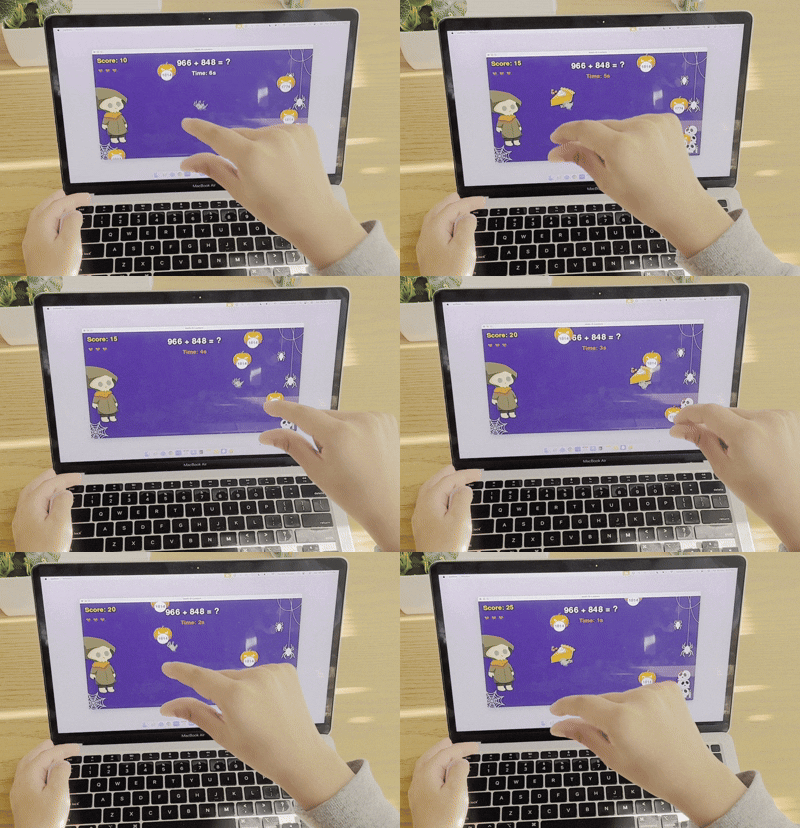
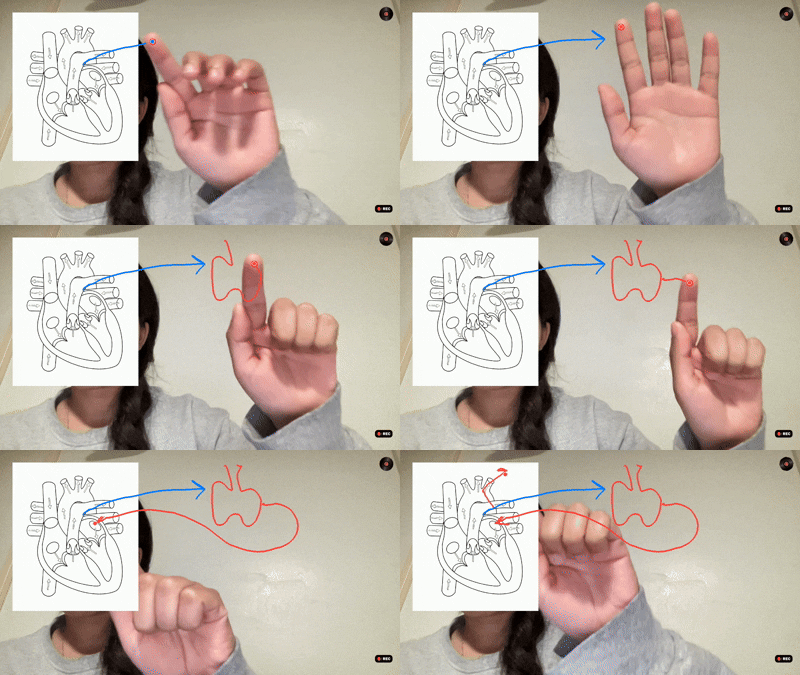
A starter template for gesture-controlled apps: MediaPipe hand, face and head tracking behind a clean Python layer, 17 ready gestures, one setup script and you are building. Two demo apps prove the skeleton: Math-O-Lantern, a pinch-to-slice math game, and Holo-Board, a tool for drawing in mid-air over your webcam and exporting one clip. Kiro's own framing of why it won: solving a specific pain point, the difficulty of vibe coding complex computer vision logic without hallucinations.
Their actual Kiro files, annotated
A hook is a trigger plus a runbook. It fires on new gesture files and walks the agent through seven numbered integration steps, ending with a demand to confirm what gesture was detected and list the files modified. That report-back is the accountability behind the claim that seventeen gestures were integrated in seconds.
Rules numbered like law: assets first, one test file as the final step, check gesture attribute names before using them, use Context7, respect the template structure, keep detection and game logic separate. Plus a hard rule that application code lives in its own folder and never modifies the core library, and an eight-step workflow ending in documentation.
Glossary-first: eighteen exact terms defined before any user story, with when-then-shall acceptance criteria. Every task traces to requirement numbers, and one task is a property-based test with named properties: the bank contains only valid operations, and operands stay within digit limits. The champions were doing property-based testing in 2025.
Context7 with auto-approve for documentation lookups, credited in their write-up with removing hallucinations on MediaPipe landmark indices. One well-chosen server with auto-approve beats five half-used ones.
- The 1st-place shape is a Skeleton Crew shape — a lean template plus two demo apps in different genres. The category brief is the winning pattern.
- Champion DNA: the same duo won the Google Cloud Run 2025 Grand Prize (Storytopia) and second place at Datadog. Browse their repos ↗.
A design-to-code platform that replaces six tools: an infinite canvas with drawing tools, wireframe-to-UI generation via AI agents, chat-based creation across four frontier models, vision references from any screenshot, a visual click-to-style editor that writes Tailwind back to source, a code explorer, and Remix the Web — a Chrome extension that captures any element from any live site and reconstructs it as an editable component. Each screen gets its own live Next.js sandbox embedded in the canvas.
- Their own page says it outright: Kiro became the orchestration engine for the entire development lifecycle. The 2nd-place write-up is a Kiro-usage masterclass — read it end to end.
- Category-naming works: the Frankenstein of UI creation mirrors the category brief verbatim.
- Chrome DevTools through MCP let the AI see their UI and self-correct — the experimentation judging box, ticked with a story.
A unified AI inbox for Gmail, Slack and Calendar. Every message runs a parallel LangGraph agent pipeline: summarization, intent classification, 0-to-10 priority scoring, action-item extraction, spam detection. Smart replies are drafted in your own voice using persona memory from your sent mail, with human approval before anything sends. Query it naturally — urgent emails this week, meetings tomorrow — on a live WebSocket feed.
- 59 correctness properties bridging spec to executable tests is the most-quoted number in their build story. Numbers like this are what thorough looks like to judges.
- A security-review hook that caught several near-misses with committed credentials — a hook with a saved-my-bacon story beats a hook that runs lint.
- Solo, unsexy productivity still badged. Depth of workflow beats team size or theme.
Strangler Studio with PHP Migration Tool
An AI-powered migration tool for teams stuck on legacy PHP. Pitch: stuck with legacy PHP code holding your team back? Meet Frankenstein Laboratory. The direct project page resisted our extractors; the gallery card opens fine from a normal browser.
- Developer tools took three of seven badges — InteractionKit, UnitSet, Strangler. Build for builders.
GeoCities reborn, but every page you build is pinned to a real place on an interactive 3D Mapbox globe. A drag-and-drop builder with ten-plus components, AI-generated pages and layouts, embeddable AI chatbots per page, shareable URLs, a My Sites dashboard, and a spooky mode with flying ghosts. The same democratized web publishing that made GeoCities magical — now that corner has coordinates.
- The vibe-versus-spec comparison with real time numbers answers the judges' write-up question — how spec-driven development compared to vibe coding — perfectly. Steal the format.
- Two words won a badge: Resurrecting GeoCities. The clearest category read of 2025.
A real-time voice debate coach: bidirectional audio streaming with the Gemini Live API, an adaptive AI opponent, instant post-debate feedback and progress tracking. Two modes, Coach and Fierce, a WebGL voice-reactive visualizer, and an analytics suite — confidence trends, duration distributions, activity heat maps — plus a persona and archetype system.
- Analytics is the proof of value: the coach claim is backed by trend charts and heat maps — performance analytics as product surface, not a marketing line.
- Repo-match honesty: the README confirms it is powered by the Kiro IDE and Gemini Live with a dedicated how-we-leveraged-Kiro section, though it never names Kiroween, so this stays at strong-match confidence.
Soulful Sessions
A Pomodoro-RPG Chrome extension: focus sessions damage Stubborn Souls — bosses with backstories about procrastination and unfinished work, each ending in a heartwarming resolution conversation when defeated. The dopamine-detox twist: game UI is hidden while you work and unlocks only during breaks. Work, then reward. Soft-discouraged versus strict-mode hard-blocked sites, ten bosses, three stats, cosmetics, idle collection, task management, streak stats.
- The shipped-store lesson: approved on the Chrome Web Store during judging — the working-app requirement satisfied by an install link anyone can click. If our entry can ship to a store, that is the strongest possible demo.
- A calming aesthetic beat aggressive productivity — design taste as differentiation, no flashy tech needed.
- Extensions are underserved — one of seven badges went to a zero-framework Manifest V3 extension.